

TLDR
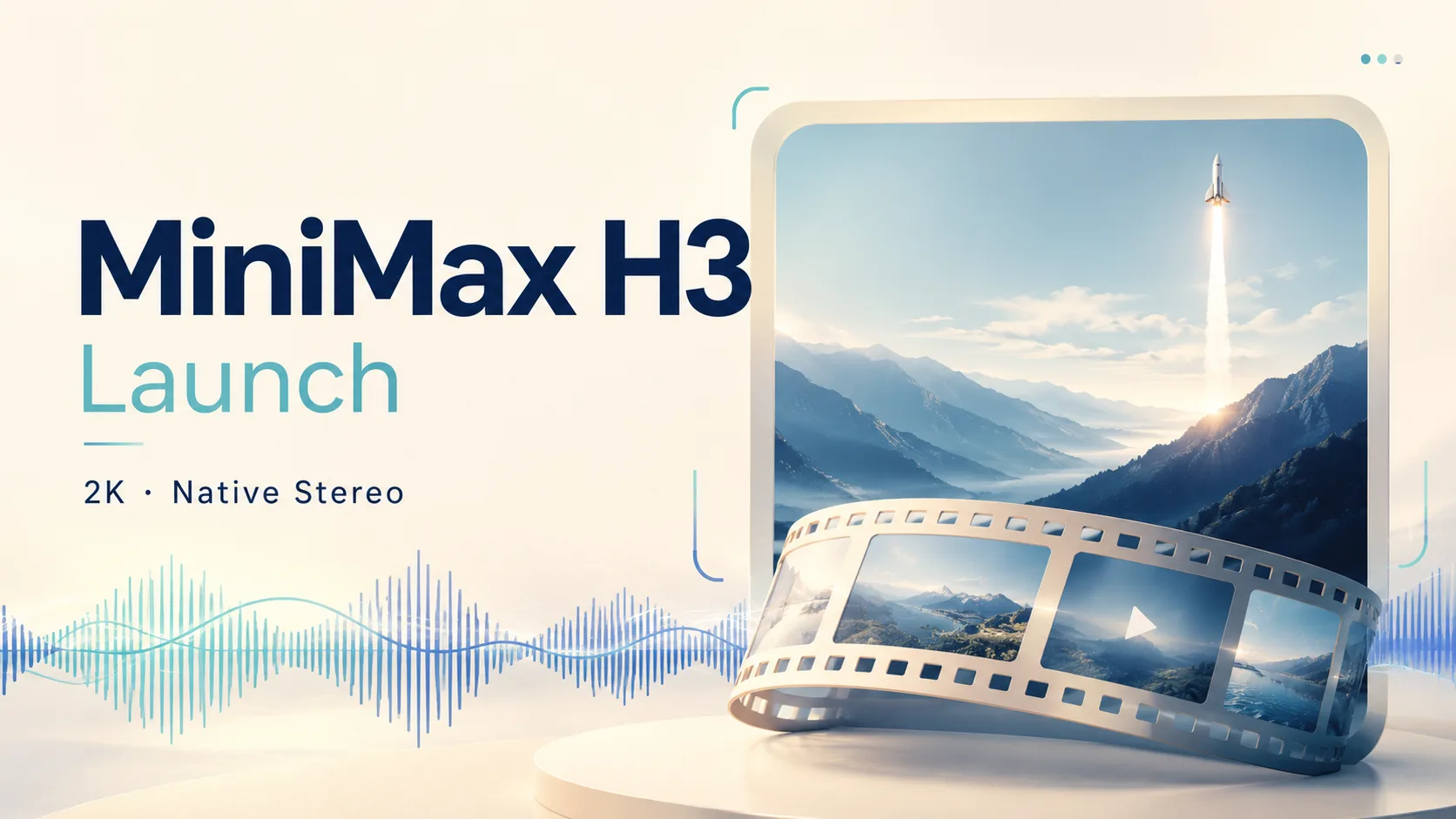
The MiniMax H3 launch (July 31, 2026) introduces MiniMax’s next general-purpose multimodal video model—successor narrative to the Hailuo video line, not the June M3 language model (official H3 post; M3 product page). Headline public claims: unified multimodal context, 2K default output, clips up to 15s with native stereo, commercial-oriented instruction following / brand text, and open weights planned “in the coming days” subject to law (official H3 post). Independent ranking snapshot: as of this writing, H3 sits at #1 on Artificial Analysis’s Video Editing (With Audio) leaderboard (Artificial Analysis). For a fast browser path, start on MiniMax H3 on this site (text-to-video or image-to-video, 5–15s, 2K).
Key Takeaways
- Ship window: Public H3 launch materials land July 31, 2026 on MiniMax’s research blog and platform release notes (minimax.io blog; platform release notes).
- Naming trap: H3 = video / multimodal generation; M3 = language model from June 2026. Do not mix coding benchmarks with video demos (H3 post; M3 page).
- Output ceiling in the official story: up to 15 seconds, 2K resolution, native stereo sound generated with the picture (official H3 post; Reuters wire recap).
- Input story: multimodal context—text + image + video + audio relationships described in language—not only a single still (official H3 post).
- Open weights: MiniMax says it plans to open model weights in the coming days, subject to applicable laws—not “weights are downloadable as of launch day” (official H3 post; follow-up X framing).
- Public ranking snapshot: Artificial Analysis lists MiniMax H3 at the top of its video-editing (with audio) table at publication time (leaderboard).
- Try path here: open MiniMax H3 on this site for short 2K text-to-video / image-to-video runs without standing up your own inference stack first.
What Actually Shipped
1. A general-purpose multimodal video pitch—not a text-model refresh
MiniMax’s launch post positions H3 as a general-purpose omni-modal generation model that “understands unified context across text, images, video, and audio” and produces video with native stereo (official H3 post). Reuters summarized the same day that the Shanghai-based firm released a video-generation model that can process text, images, video, and audio, generating clips up to 15 seconds in 2K with native stereo sound (Reuters).
That is a video launch. If you still have June’s MiniMax M3 language-model write-ups open, close them before you compare numbers (M3 page).
2. 2K + native stereo as the default product story
Official copy stresses 2K by default and native stereo rather than silent 720p clips plus a separate TTS pass (official H3 post). The platform models page mirrors the date stamp: Jul. 31, 2026 — MiniMax H3 as a new-generation open general-purpose multimodal video model (release notes).
Treat third-party “24fps” mentions as reported, not always vendor-pinned in the main blog prose—verify on the exact endpoint or UI you use.
3. Multimodal context and “in-context” control
The launch demo narrative is not “one noun, one camera move.” MiniMax describes prompts that bind relationships across modalities—for example, reference a camera move from a video, a character from an image, and vocals from an audio clip in natural language (official H3 post). Named commercial lanes in the same post include advertising, branding, e-commerce, product design, UI/UX, and gaming.

Multimodal short-clip style sample · showcase still on MiniMax H3
4. Family lineage: Hailuo 01 → Hailuo 02 / 2.3 → H3
MiniMax’s own H3 write-up frames prior generations: Hailuo 01 built the system; Hailuo 02 improved efficiency, data, and scale; H3 pushes task generalization across siloed image/video/audio jobs (official H3 post). Earlier public Hailuo posts remain useful lineage anchors—for example Hailuo 02 (1080p / multi-second video) and Hailuo 2.3. Community nicknames like “Hailuo 3.0” appear in secondary coverage; MiniMax’s own H3 page and release notes brand the model as MiniMax H3.
5. Architecture buzzwords (claims, not independent teardowns)
The official post names several internal systems: Contextual Omni Representation, H3-VAE, H3-Omni Transformer, and In-Context Regeneration for high-resolution output without a separate super-resolution bolt-on (official H3 post). MiniMax also says a full technical report is coming. Until that report and third-party reproductions land, treat architecture names as vendor labels, not peer-reviewed proofs.
6. Open-weights promise vs. day-0 availability
Launch marketing leans hard on openness. The primary post says MiniMax plans to open weights in the coming days, subject to laws and regulations, to support hardware compatibility and custom builds (official H3 post). Official X follow-ups keep the same “open for anyone to build on” framing (@MiniMax_AI). Honest status for builders: API / partner surfaces first; self-host weights when (if) a public checkpoint and license appear—do not plan infrastructure on a press release alone.
Deep dive: capability themes that matter
Multimodal context over single-mode prompts
If your current workflow is “image-to-video only,” H3’s launch story is wider: language as the bridge that describes how references relate (official H3 post). That is why launch demos lean on advertising and brand systems—not only vibe clips.
Instruction following, text, and brand rendering
MiniMax explicitly calls out instruction following, accurate text and brand rendering, and V2V motion transfer as commercial strengths (official H3 post). Practical rule still holds: zoom-check every on-screen string before you ship paid media.

Start/end frame control job family · showcase still on MiniMax H3
Price-performance (vendor claim only)
MiniMax states that at 2K, H3’s per-second price is less than a third of “mainstream models,” with a cheaper 768p tier mentioned in the same post (official H3 post). We do not reprint third-party price war tables here—those numbers move daily and pull you into shopping mode instead of evaluating your brief. If unit economics matter, pull the live rate from the surface you will actually bill against after a pilot.
Leaderboard signal (independent table, not a guarantee)
Artificial Analysis’s public Video Editing (With Audio) table currently ranks MiniMax H3 first among listed models (leaderboard). Leaderboards are useful snapshots—they are not a promise that H3 wins every ad brief, face consistency test, or 30-second long-form job against longer-clip competitors.

Product / commercial motion sample · showcase still on MiniMax H3
MiniMax H3 vs nearby signals (capability lens, not a price sheet)
| Signal | What public materials emphasize | Practical reading |
|---|---|---|
| MiniMax H3 | Multimodal context; 2K; ≤15s; native stereo; open-weights plan (H3 post) | Short commercial clips + reference-driven control when the host exposes those inputs |
| MiniMax M3 | Language / agentic / long-context model (M3) | Wrong comparison target for video quality |
| Earlier Hailuo (02 / 2.3) | Progressive video quality & motion posts (Hailuo 02; 2.3) | Family context; H3 is the launch-week headline |
| Same-week video rivals (press framing) | Reuters frames competition with other Chinese video labs (Reuters) | Market heat is real; pick by your brief, not launch theater |
What We Know vs. What We Don't
| We know (sourced) | We don't know / won't claim |
|---|---|
| Public MiniMax H3 launch dated July 31, 2026 (official blog; release notes) | That every partner UI exposes full omni-reference (12-file) stacks on day one |
| Official output story: 2K, up to 15s, native stereo (official blog; Reuters) | Pixel-perfect brand legality without a human pass on on-screen text |
| Open weights are planned, not proven shipped as a public checkpoint in the launch post itself (official blog) | A stable self-host license + hardware recipe until weights + docs appear |
| Artificial Analysis lists H3 at the top of its video-editing (with audio) board at this writing (AA) | That H3 “beats every model on every creative job forever” |
| Browser try path: MiniMax H3 for short 2K t2v/i2v | That every official demo modality is identical on every host |
Why this matters for builders
- Short-form video is consolidating multimodal inputs—language + stills + motion refs + audio refs in one generation pass (official H3 post).
- Native audio changes review criteria—judge lip-ish timing, ambience, and music bed as part of the take, not a post step.
- Open-weights plans keep ecosystem pressure on closed video stacks—but only if checkpoints actually ship (official H3 post; X follow-up).
- Browser evaluation beats waiting for a perfect local install when you only need to know if your product angle survives a 5–15s crop.
How to evaluate MiniMax H3 yourself
- Open MiniMax H3 on this site (model surface for short 2K clips).
- Pick duration first (5–15s). Short pilots waste fewer retries.
- Run text-to-video with Prompt A, then image-to-video with a real product still if you have one.
- Judge at 100% zoom: subject stability, on-screen text (if any), camera intent, and whether audio (when present on your host) matches the picture.
- Save keepers only after a second pass with a tighter prompt—not the first lucky vibe.
Prompt A — product hero, 16:9
Cinematic product hero shot, 16:9, soft studio lighting, soft teal rim light.
A matte black wireless earbud case floats slowly toward camera on a clean white seamless backdrop.
Subtle camera push-in, shallow depth of field, commercial advertising grade, no logos, no watermark, no extra props.
Prompt B — street fashion, vertical 9:16
Vertical 9:16 fashion clip, golden hour city street, shallow depth of field.
A model in a red trench coat walks toward camera in slow confident steps, coat fabric moves naturally in light wind.
Handheld micro-shake, realistic skin texture, natural color grade, no text, no watermark, no logo.
Prompt C — first-frame product demo (image-to-video)
Keep the product identity locked from the first frame.
Slow 30-degree orbital move around the product, soft reflections on the table surface, gentle light sweep.
Premium e-commerce demo look, stable geometry, no morphing logos, no extra objects entering frame, no watermark.
What to watch next
- Weight release: does a public checkpoint + license appear after the “coming days” window (official H3 post)?
- Technical report: MiniMax promised a fuller H3 report (official H3 post).
- Host parity: which UIs expose full multimodal refs vs. simpler text/image-to-video only.
- Leaderboard churn: Artificial Analysis tables update as samples accumulate (AA video editing).
- Same-market pressure: Reuters already frames H3 inside a competitive Chinese video-model race (Reuters).
FAQ
What is the MiniMax H3 launch date?
Public launch materials are dated July 31, 2026 on MiniMax’s blog and platform model release notes (official blog; release notes).
Is MiniMax H3 the same as MiniMax M3?
No. H3 is the multimodal video generation model from the July 31 launch. M3 is MiniMax’s June language model line (H3 post; M3 page).
What resolution and length does H3 claim?
Official launch copy: up to 15 seconds at 2K with native stereo sound (official blog; Reuters). Host UIs may expose a narrower subset—check the generator you open.
Does MiniMax H3 generate audio with the video?
MiniMax’s launch materials say yes: native stereo is part of the generation story (official blog). Always verify audio behavior on the specific product surface you use.
Are MiniMax H3 weights open today?
As of the launch post, MiniMax plans to open weights in the coming days subject to law—it is a promise, not a proof of a public downloadable checkpoint (official blog).
How does H3 rank on public video leaderboards?
On Artificial Analysis’s Video Editing (With Audio) leaderboard, MiniMax H3 is listed at the top at the time of this article (Artificial Analysis). Rankings move; re-check before you cite a number in a pitch deck.
Who is H3 for?
MiniMax names advertising, branding, e-commerce, product design, UI/UX, gaming, and related commercial content jobs (official blog). Short social and product demos are the natural first pilots.
How do I try MiniMax H3 without self-hosting?
Open MiniMax H3 on this site, choose text-to-video or image-to-video, set 5–15 seconds, and run one of the prompts above. You can also start from this site’s video workspace or home page CTAs that route to the same model page.
Is this site MiniMax official?
No. This is an independent MiniMax H3 resource and try funnel. For vendor-authoritative claims, prefer minimax.io and platform.minimax.io.
Should I wait for open weights before testing?
Only if self-hosting is a hard requirement. For creative evaluation, browser generation on MiniMax H3 is enough to stress your prompts this week.
What should I test first after the MiniMax H3 launch?
One product hero prompt, one vertical social prompt, and one image-to-video lock on a real SKU photo. Compare subject stability and any on-screen text before you batch a campaign.
About Casey Ren
Casey Ren is an AI video model analyst who tracks MiniMax / Hailuo releases and turns public launch claims into clear try paths. She writes numbers-first launch roundups on MiniMax H3.